Resources
Welcome to our Resources page. Here you’ll find factsheets, explainer videos, informational videos, vodcasts and infographics, from our team and industry thought leaders. Feel free to browse, grab what you need, and come back for new additions on unclaimed financial assets and corporate asset recovery best practices.
Explainer Videos
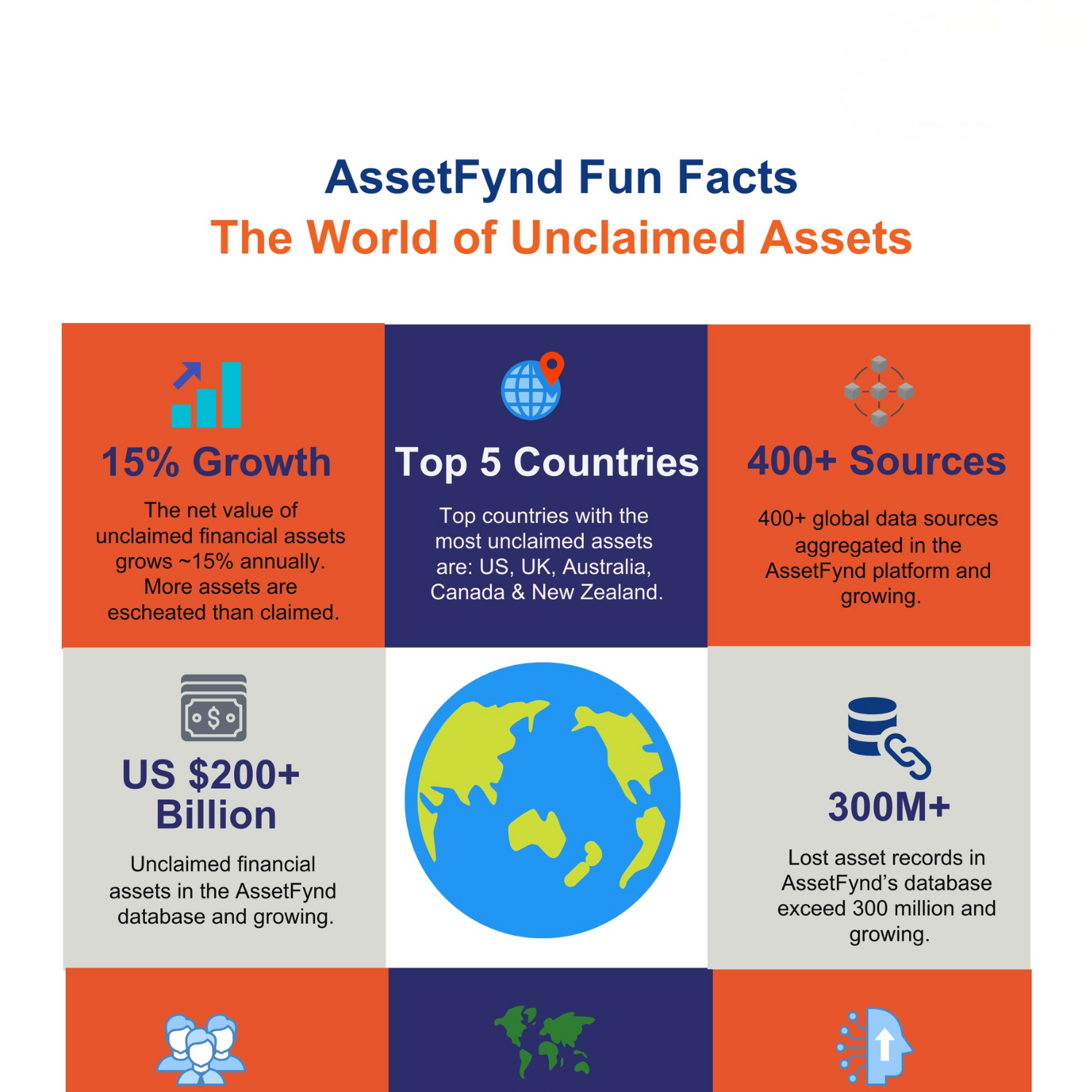
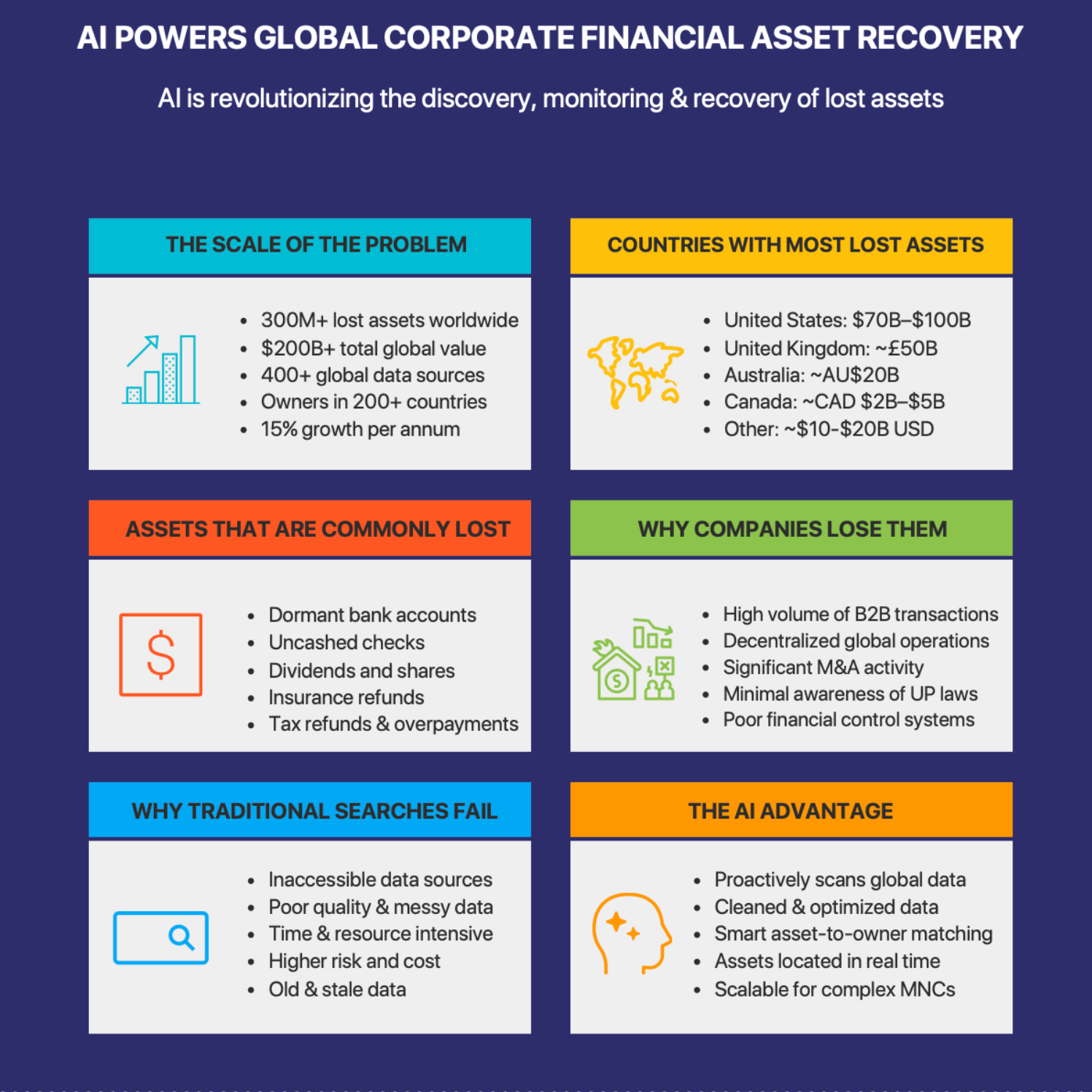
AssetFynd, the future of financial asset recovery. Most unclaimed asset recovery platforms are stuck in the past. Clunky, slow and manual. AssetFynd was built to change that. We've reimagined the entire process with cutting edge technology, AI driven intelligence, and a relentless focus on automation. The result? A faster, smarter, and far more effective way to discover and recover financial assets globally. AI isn't just a feature, it's our foundation. We integrate powerful advancements in artificial intelligence, including large language models, across every step of our process. This means lightning fast performance, immediate search results, and smarter asset to owner matches. Asset searches take seconds, not hours or days like outdated legacy systems. Our proprietary intelligent continuous search system, also known as AssetFynd alerts, means the hunt for additional assets never stops. As new data is ingested, Assetfynd automatically reruns queries and notifies you of new matches. And when we are talking about lost financial assets, we mean bank accounts, insurance refunds, unclaimed vendor checks, bankruptcy dividends, tax refunds, and overpayments, to name a few. Lost assets truly find you. We're building the world's largest centralized unclaimed asset database, currently holding approximately three hundred million financial assets from close to four hundred global sources for asset owners in over two hundred countries. This is at least three to six times larger than most competitors. AssetFynd uses AI powered asset discovery to analyze these variations and determine when records point to the same company or individual, even when the information is imperfect. While the AssetFynd name is new, our team brings decades of proven expertise, having recovered tens of millions for global corporations and government agencies. Our fully automated click and claim process will minimize human error, speed up recovery, and keep all data secure. The time is now to reinvent your financial asset recovery. For more information on how AssetFynd can help you, visit assetfynd.com.
AssetFynd Advantage
Informational Videos
In addition to strategic alliances, AssetFynd delivers our asset recovery services directly to corporations, governments, and charities. We work specifically with companies in the financial services sector, banks, insurance companies, brokerages, as well as multinational corporations. We also work with charities and government agencies. Our goal is to help our clients locate and recover their lost and unclaimed financial assets anywhere in the world.
Direct Clients
At AssetFynd we work with the top unclaimed property consulting firms to help them add even greater value to their corporate clients. The unclaimed property services market is moving to a more full service model where companies are now expecting and in some cases even demanding that they get the synergy and benefits of combining unclaimed property consulting, compliance, and asset recovery as one solution. The benefit of adding asset recovery for clients is quite obvious. They can now offset some of those mandatory escheatment costs that they're subject to annually. For unclaimed property consulting firms, they can now deliver a world class solution to their clients without any heavy investment in technology or other resources.
UP Consultants
At AssetFynd we support corporate insolvency professionals by helping to locate and recover lost and unclaimed financial assets that were not on the balance sheets of insolvent entities. The primary benefit to corporate insolvency trustees, liquidators, receivers, or other advisors is that we help you satisfy your fiduciary and legal duty of care to creditors and the courts by ensuring that all assets are collected. The benefit for creditors is the additional recovery of assets that would have otherwise been missed. At AssetFynd, we will deliver real time lost asset information for all of your corporate insolvency engagements.
Corporate Insolvency
AssetFynd supports wills and estates lawyers, executors, and executor support firms by locating and recovering all lost financial assets for a deceased person's estate. We help wills and estates practitioners satisfy their fiduciary and legal duty of care to courts and beneficiaries by ensuring that all lost financial assets are located and recovered. The beneficiaries further benefit from the additional assets that AssetFynd is able to locate and recover that would have otherwise been missed. AssetFynd will provide proactive real time updates on all additional assets that are located for a deceased person's estate.
Wills and Estates
Vodcast: Fynders Keepers
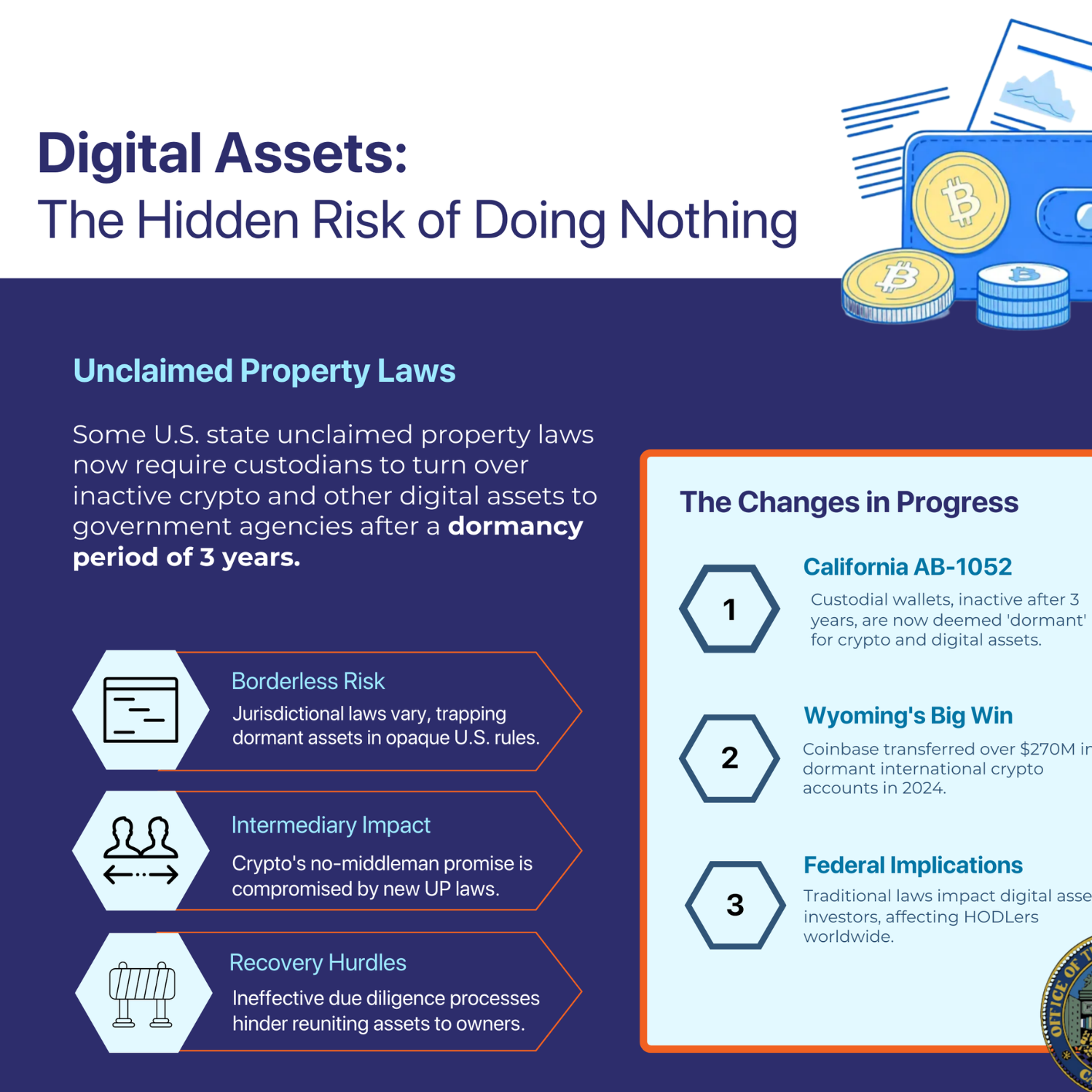
Welcome to Fynders Keepers, the vodcast powered by AssetFynd. Here, we talk with the people shaping the future of global financial asset recovery from industry veterans to technology innovators. Each episode uncovers new insights, real world challenges, and the emerging tools helping companies locate and recover billions in unclaimed financial assets worldwide. If it touches finance, data, or discovery, we're talking about it here. This is Fynders Keepers, where every conversation uncovers something worth finding. Well, everybody to episode one of Fynders Keepers, the AssetFynd vodcast. Today, we are going to talk about something that we would call the hidden transfer. It is the history and mystery of how corporate assets quietly change hands. And I am thrilled to be joined today by Tom Lowe. A little bit more about Tom in a second. But, you know, every year, billions of dollars in corporate assets sort of quietly vanish from the company balance sheets. But actually, you know, they don't vanish. They actually get transferred into the hands of governments under very ancient rules called bona vacantia and escheat. To help unpack this mystery, I'm joined by King's counsel Tom Lowe, one of the top legal minds in cross border insolvency and international asset dormancy. Tom has acted in hundreds of high profile and cross border cases before courts and tribunals around the world. Welcome, Tom. Thank you. That's an excessive introduction for me. I'm top legal mind, and I think international asset dormancy is a fairly well known concept where you don't need a top legal mind. Well, that would be expected that you would speak this way. Let's dive in if we can, Tom. And as I'd mentioned those terms, you know, bona vacantia and escheat are terms that are used a lot in the unclaimed property world, but there's a whole history behind this. Can you unpack sort of the genesis of these two words and how they have come to become what unclaimed property laws are today? Well, they have different origins. Mean, Bona vacantia was a concept that the Romans used literally when property became ownerless. That's what it means, ownerless property. And originally, anyone who could find that property, once it became ownerless, could take it. You can imagine that led to quite a lot of crime, where you've made sure that you could do this. So what they then did was they started giving the treasury the entitlement. So that's the origin of chattels and goods going to the state when they become ownerless. And that was carried on by the common law in England in the sort of thirteenth century onwards, and the commentaries differ about the precise date when it was brought in. Meanwhile, the concept of escheat came into English law through, and it only related to land law, it didn't relate to leaseholders real property that was freehold and so on. The origin of that is the Norman feudal system, which had a theory that everything was really derived from a grant, through feudal lords to the tenant from the crown. So when someone died without successors, the property would go to the feudal lord, and if he was dead, it would go to the crown. And the purpose of that was that real estate, if real estate was empty and had no owners, then you couldn't collect taxes, and you also couldn't enforce certain other property related laws. So it was important for real estate to have this succession back to the crown. It was never, you know, when of course England was ruled by kings, it went into their coffers, but it was really reverting to the state. And in the US, they've used escheat rather than the concept of bona vacantia to mean all the succession to goods, personal, financial and real estate. But in reality, that's the historical origin. And when companies started to come into existence, they applied it to dissolve companies. When a company has been wound up and has no longer got anyone running it, and there's no one claiming to manage it, the company ceases to exist, and its ownership and assets ceases to exist. And that was in common law treated as bona vacantia. In nineteen twenty five, it was made statutory in England. And since then it's been made the subject of statutes throughout the common law world. No, it's fascinating. I love to sort of understand the depth behind it. It must have been a pretty tumultuous time back then, and everything was sort of being transferred to the king, which sort of can be related today, in today's world, to the government that they were in then. You talked about how it applies to dissolved companies. I want to get to that a little bit later, but I want to know, with these terms, talked about property going to the kings. Today, let's talk about, there are so many active companies out there that have millions of unclaimed property out there. How does that work today? How are these laws applied today? Well, main thing is that you can see what the purpose of it was originally. What's happened in the statutory laws is that you have, in a number of countries, you have something called dormant account laws, and you have other similar laws that apply to other assets. The purpose of that was to let the banks declutter their balance sheets. Now it means that property becomes ownerless, effectively, treated as ownerless. It has nothing to do with dissolution of the company often. This can happen to anyone, individual or company, that after a while the banks just treat you or the brokers treat you as not being around anymore, and then treat your property as being escheted in the US or treated under some dormant account system in other countries. Right. And, you know, just the word dormant and dormancy again is used a lot in unclaimed property. When you're speaking of dormancy, you're talking about essentially that point where? Yeah. In England, I think it's six years because that reflects a sort of limitation argument. In the US, I don't know if it's as long as that, it also varies I see in the US, I believe. Yeah, it's a state matter, not a federal matter in the US, so it does vary considerably. And often it's just three years. If you don't touch your account, then after three years, you're treated as having abandoned it. Right. And it's, again, if you kind of go back to the history where it was generally, you know, if soldiers died or people died, then of course that property was then transferred over and taken over by the king. You know, in today's world, you know, sadly, the discussion here is it's not just about deceased people or dissolved companies. You know, you can be alive and well, and a very active company and a very active individual. But if you're not doing what you need to do to ensure that you're keeping your accounts from going into dormancy, chances are there's going to be some money out there that belongs to you. Yeah, I mean, one can be cynical about this, but it's really, it's a modern thing that you can take property away from people because they just choose not to trade in their account or withdraw money. You know, there are often good reasons for that. Right. So tell me a little bit about, we can get to sort of completely dissolved companies, which is sort of fascinating. How about somewhere in the middle? So we know with active companies, there can be funds out there that, you know, are remaining with you know, when they move, there's so many things that contribute to these financial assets being lost. Then you sort of have this middle road of an inactive company that's not yet dissolved, that's either going through a bankruptcy or insolvency. How does that all sort of work? Well, as you said, the escheating in the US, for example, has nothing to do with whether you're dissolved, whether you're dead, or whether you're a soldier that's died in battle. It's got nothing to do with those things. It's simply to do with inactivity of your assets. And of course, in a brokerage account, it's quite common that people have passive holdings in things and don't deal with them, especially if the accounts have metals or other sort of assets. And that's really when a company is wound up, it's a question of someone coming in as a bankruptcy trustee or as a liquidator in our system and not being able to necessarily trace all the accounts. Know, they've sometimes, especially when the company has been badly managed, the records may not be available to the liquidators, they may have difficulty in reconstructing them, and they may not find all their assets. And that's really quite common. They have obviously ways of tracing what happened in the company, but generally speaking, there are often in liquidations difficulties in identifying assets. So, you know, we've talked active companies and those that are going through dissolution actually have been dissolved, liquidation and are actually at the point of being dissolved. I know that there's a story that you've talked about in the past where you came on board, I believe that the company was dissolved in nineteen ninety nine. And literally seven years later, you got involved and were able to find a significant amount of money. I believe it was in brokerage account for this particular case. Can you walk me through that real life case? Well, I think that was an instance where the founder of AssetFynd has identified the assets. This is sometime after dissolution. In Cayman, for example, and other countries where dissolution occurs, you have a sort of limited period after the liquidators disappear, the company is dead, and the government holds the assets on a sort of trust arrangement for about a year, and then the original owners can come forward. After that, it goes to the crown. Your founder, Darren, had identified some assets for a company that had been liquidated for some time, but he had to go to the government, who then are the owners of the assets, to persuade them to give them to him for a fee or whatever it is. And that is quite common that people do that when they're connected with a company, they realize that. But in Darren's case, he'd found this maybe because he'd been asked. I don't know the details of that. But that is something that happens here, that people go back to the crown because we don't have the same sort of dormant account system. And for other financial assets that they get the crown, here the crown is the Cayman treasury, not the king, you know. Crown doesn't mean the king, it means the governments who are doing this, it's not the king who's doing it. And they then negotiate the release of the asset, whatever it is. If it's cash, they're going to want more than if it's a difficult asset to collect. Right. I think through this discovery again, and I'd love for you to talk about this, you know, as I've been digging deeper into this industry, I am always surprised and baffled by how people can have, or a company can have assets have operated in one jurisdiction or even one company. And yet their assets are escheated to a completely different country, government jurisdiction. It it and it it's all happening, as we said in the beginning, sort of very quietly, and it almost seems under the radar, but it's just it's just because it's sort of happening very silently. What is causing what is causing this crazy transfer of funds within different countries and jurisdictions? If you could walk us through your experience. Well, as most dollars are in the US, a lot of financial assets in the US. So people who incorporate in offshore jurisdictions will almost always have assets in the US. There are people incorporated here. That's because they've invested in some other country, and they want to make sure that in a globalized world, if other people invest in Cayman, you know, they're not taxed in the US, but they can have their assets in the US. So you have a lot of international companies which have assets in the US. A lot of foreign companies do. So that's why very often they have to then look to the US system. I suspect that doesn't apply to some of the other countries where these people come from, you know? Right. So I think the problem with this escheating is, and the solutions to it, are primarily common law countries. Makes sense. And you wrote a very highly regarded opinion on this several years ago. What sort of takeaways did you have from that opinion or sort of high level perspectives or thoughts from that opinion that you wrote? Well, my opinion was primarily concerned with the principles applicable to dissolved companies and the origins of the principles. I mean, been allowed to talk about it because normally I'm not allowed to talk about these things. All right, great. Shoot. Okay. So, I mean, this opinion was really the occasion of it's a good illustration of what happens if you have unclaimed property other than bank accounts. The founder of AssetFynd, Darren, had identified some assets that belonged to a company that had been long dissolved. They went to the crown in Cayman, not not the actual king, because it's not the king who really has anything. It's the treasuries of these countries. And he had to he used this opinion to explain to the government that they owned the asset because they didn't really appreciate that. Then that enabled him then to negotiate for the release of the asset. And there's a value negotiation that goes on that depends obviously on the kind of asset because the government's quite keen to hang on to cash when they have it. So that was the function of the opinion. The opinion itself merely explained the concept of the common door concept of bona vacantia achievement. Of course, it's now in the Companies Act, but personal bona vacantia is still the same. It's a common law principle here. So yeah, that was really the context and significance of the opinion. Great. So we've talked about sort of the history around these, you know, ancient rules and laws and sort of how they've sort of evolved to some degree today, how it's dealt with with active and active companies, dissolved companies fairly similarly. You know, there's some similar foundations. Now I wanna shift a little bit to talk about the world that we're in today. It's a world where everything is, you know, AI, powered by AI. It's evolving at warp speed. And we also have digital assets, which of course did not exist back in the day. So I guess the thought is, do those, you know, ancient rules, which have evolved to some degree today, do they still make sense? If not, should they be evolved today? Well, the problem about AI assets, digital assets rather, is to do with recognizing them as property. In some countries, in most common law countries, that's been achieved by looking at features of the digital assets and equating them with traditional property. The reason the old principles still work is because they were there to deal with the problem. They were there to deal with the fact that you can't have in any kind of state all sorts of abandoned assets, like used cars littering a field. You can't do that. So you need to have a system to take control of them. And the balance you have to reach is that you obviously don't want to be confiscating assets too early. And that's, as I said, a bit of a problem when you're dealing with financial assets like digital assets, because there's a I mean, I don't know if you've read recently, was an example of someone with a coin wallet that was fifteen years old or something and hadn't been touched. And it had gone from being a few dollars to a couple of million or something, you know, and that is very common with financial assets that they don't get moved for a long time, you know, some people who are not active investors. And the fact is that I think something like a digital wallet is particularly good example of an asset that shouldn't really escheat, but it's done by statute. And so the RUPER laws that they have in the US, which have now, it's a uniform law, which states are free to adopt, imposes these dormancy rules on digital assets and other financial assets, and it shortens the dormancy period. It regulates people who find the assets, but the real problem is that it's now going to be more common for people to have lost their money. It's overwhelming. And I guess you also think that, I mean, you're losing, when you talk about crypto, you lose the passkey and that's a whole other challenge. So I think it's going be a bit of a mess going forward. Well, that's a very good point because in relation to losing your wallet, as I understand it for a lot of the digital currencies, it's impossible for anyone to take them. So it doesn't, you know, if you die, no one gets it. It becomes ownerless. That's right. And they haven't actually dealt with the problem of ownerless digital assets in that way properly. But I suppose the idea is that the exchanges or the people who manage these wallets then have the obligation to escheat them to the relevant agency in the US. But they're not all in the US. They don't all exist in the US. I think it's gonna get very interesting. And so we'll be watching how various jurisdictions and countries will sort of handle that as it progresses. I mean, again, the key is as much as possible to stay on top of all of your accounts at whatever level more so now than ever, I think. In a perfect world, Tom, in a perfect world, which we don't live in, but we can think about Utopia for a second, what would you want how would you want the escheatment of financial assets to be, that world to be changed to make it easier, better, more fair? If you could wave your wand, what would you want to see happen? I like the world to be in a form where people can recover their assets, because there really is always a successor or somebody who has an interest in the estate in some way or other, but just not a legal one. And also, particularly when the assets have been escheated on grounds of statutory dormancy rules, it's very important that people can recover those assets because that's an artificial way of taking them away. Right. And I guess, would it make things, the world a lot easier if the actual unclaimed property laws, including dormancy periods, etcetera, were just, for the most part, quite the same across countries and jurisdictions? Wouldn't it just make it so much easier rather than having to stay on top of your particular state and how that impacts you depending on where you live and so forth? Well, I mean, there are not many. I think it's mainly large institutions who would find that helpful, because if I have a dormant asset, I'm probably not going to have ten. If I have one and I have to go to Delaware, I'll find out what Delaware says. If I have two, uniformity is more important. People don't plan to have dormant assets, the people who have a lot of dormant assets are financial institutions, and it would help them to recover assets if it was all uniform. But it isn't, and it's a minefield because of that. You know, that's really the problem. And RuPo is designed to create uniformity. And I think that's primarily to assist bigger holders of assets who lose bits of their accounts all over the place quite often. So tell me, Tom, have you ever lost any financial assets? Well, I had some money in a brokerage account many years ago, which I I gave someone access to trade, but then it never was traded. I'm not an investor myself, so I didn't touch it. But a few years later, I tried to get my money back. And they said the brokers were not interested at all. They wouldn't help me. And I tried to find out, you know, you couldn't go through chat GPT those days, you had to Google it, and I got absolutely nowhere, and I gave up after a while. It just wasn't worth it. AssetFynd came along and located them and enabled me to make a claim. What's really odd and surprising to me about that was that I put these assets away over ten years ago. Right. So I would have had no hope of recovering them in any ordinary scenario because the limitation period would have expired a long time ago. And the fact that these assets can now be recovered, long forgotten assets often, was a big surprise to me. Right. And are you comfortable sharing how much or range of how much those assets were? Assets came from? Well, was about the amount of an expensive car. Oh, well, that's pretty good. Are you in the market for a new car? I'm not at the age where I want new cars. Well, I'm sure you'll put it to good use, but it certainly is a nice bonus to be able to find that when you actually thought, you know, it to my children. There's always a somebody, a successor to an asset, even within your family. Tom, one thing I'd like to sort of end on that we ask all of our guests, is there one asset, financial or not, that you really would never want to lose? Well, most obvious thing for someone in my position is one's home. That's obviously the thing you don't want to lose, but you can't lose your home to the crown that easily, you know. My personal possessions are dear to me, obviously, but those things formerly would, you know, there's just no way that things like that in modern times really go back to the crown. Although that was the Roman rule, that people would come and murder me so they could claim my property. Yeah, well, you know, we're living in different times now, different kinds of challenges, but certainly sounds like it was a fascinating time. You know, this has been a great discussion, Tom. We've learned so much about international law and unclaimed property in the history, which I think a lot of people would be surprised to hear how it came about. At the end of the day, assets get lost. They don't disappear. They actually just get transferred from owner to owner and into the hands of what we know as the government. The idea is to stay on top of it to make sure that you are able to claim your assets or never have them go dormant to begin with. Once they do and they get escheated and you're looking to find those assets, that's where our AssetFynd comes in, we find your assets globally. So thank you everybody for listening today and we hope to see you soon. Thank you very much.
Episode 1: The Hidden Transfer
The History and Mystery of How Corporate Assets Quietly Change Hands.
Guest: Tom Lowe, King's Counsel